How to write Crochet Patterns
By knotorious.loops·
Want to create your very own Crochet Patterns?
So, you’ve made a super cute amigurumi avocado, or maybe a granny square that doesn’t look like it was made by a distracted raccoon, and now you're thinking, “Hey, I should write a pattern for this!" First of all—congrats! You’ve officially entered the wild, tangled world of pattern writing. Welcome. We have snacks. (Just don’t get crumbs on the yarn.) Here’s how to write your very own crochet pattern, in a way that makes sense to other humans—not just future-you three months from now who forgot what “weird magic loop thingy” means. And if you haven’t designed your own piece yet, check out our guide on how to design your own Amigurumi first.
The Basics — pick your terminology
Before you write a single stitch instruction, you gotta pick a lane. Just like how British English and American English can't agree on what a “biscuit" is, crochet has US terms and UK terms — and they are wildly different. A US single crochet is a UK double crochet. Yeah. It's chaos. So step one: decide which terminology you're rolling with and slap a big fat note at the top of your pattern so nobody gets confused. Most pattern marketplaces and crocheters online default to US terms, so that's usually the safe bet if you're unsure.
Rows vs. Rounds
Crochet patterns are structured as a sequence of either rows or rounds — and which one you use depends on what you're making. If you're working flat (like a blanket or a scarf), you're working in rows — you go back and forth, turning your work at the end of each row. If you're working in a spiral or joined circle (like most Amigurumi), you're working in rounds — you go around and around, like a little yarn hamster wheel. Some patterns even mix both, so just make sure you label each one clearly. Your future readers (and future you) will appreciate it.
The Stitches — abbreviations are your best friend
Nobody wants to read “single crochet single crochet increase decrease single crochet" over and over again. That's a mouthful and your eyes glaze over by row 3. That's why crochet patterns use abbreviations for all the different stitch types. Here are the ones you'll use the most:
- ch — chain
- sc — single crochet
- inc — increase (2 sc into the same stitch)
- dec — decrease (2 stitches merged into 1)
- sl st — slip stitch
- dc — double crochet
- hdc — half double crochet
- tr — treble crochet
- MR — magic ring
Repetitions — because nobody wants to write sc 47 times
Here's where pattern writing gets elegant. Instead of writing out every single stitch individually (please don't), you use repetition notation. If a sequence of stitches repeats, you wrap it in brackets or parentheses and note how many times to repeat it. For example:
- [sc, inc] x 6 — means “do one single crochet then one increase, and repeat that combo 6 times"
- sc x 12 — means “do 12 single crochets in a row"
Stitch Counts — the safety net of crochet patterns
Now, on to one of the most important and idiomatic aspects of crochet patterns: the stitch count. At the end of every single row or round, you add the total number of stitches that should be on the hook after completing that row/round. It usually looks something like this:
- Rnd 4: [sc, inc] x 6 (18)
What else to add?
A good pattern isn't just stitch instructions — it's a whole little package. Here's what you should include alongside the actual pattern:
- Materials list — yarn weight, hook size, safety eyes, stuffing, whatever they need. Be specific. “Some yarn and a hook" is not a materials list.
- Skill level — is this beginner-friendly or does it require someone who knows what a front post treble crochet is without googling it?
- Gauge — especially for wearables. For Amigurumi it matters less, but mentioning the approximate finished size with your yarn and hook is still helpful.
- Assembly instructions — if your pattern has multiple pieces (like most Amigurumi do), tell people how to put them together. Where do the arms go? How far apart are the eyes? Include photos if you can — a picture of where to sew the ears is worth a thousand words.
- Terminology note — US or UK terms? Say it loud and clear.
- Special stitches — if you use anything that isn't standard, explain it or link to a tutorial. Don't assume everyone knows the bobble stitch.
Make writing crochet patterns a breeze with hard frogg's life
Coming up with the shapes is one piece of the big puzzle of designing crochet patterns and Amigurumi. Another essential part is adding control elements such as stitch counts and verifying if your pattern actually makes sense and all your stitches add up. This is where the hard frogg's life crochet will save you tons of time (and nerves)!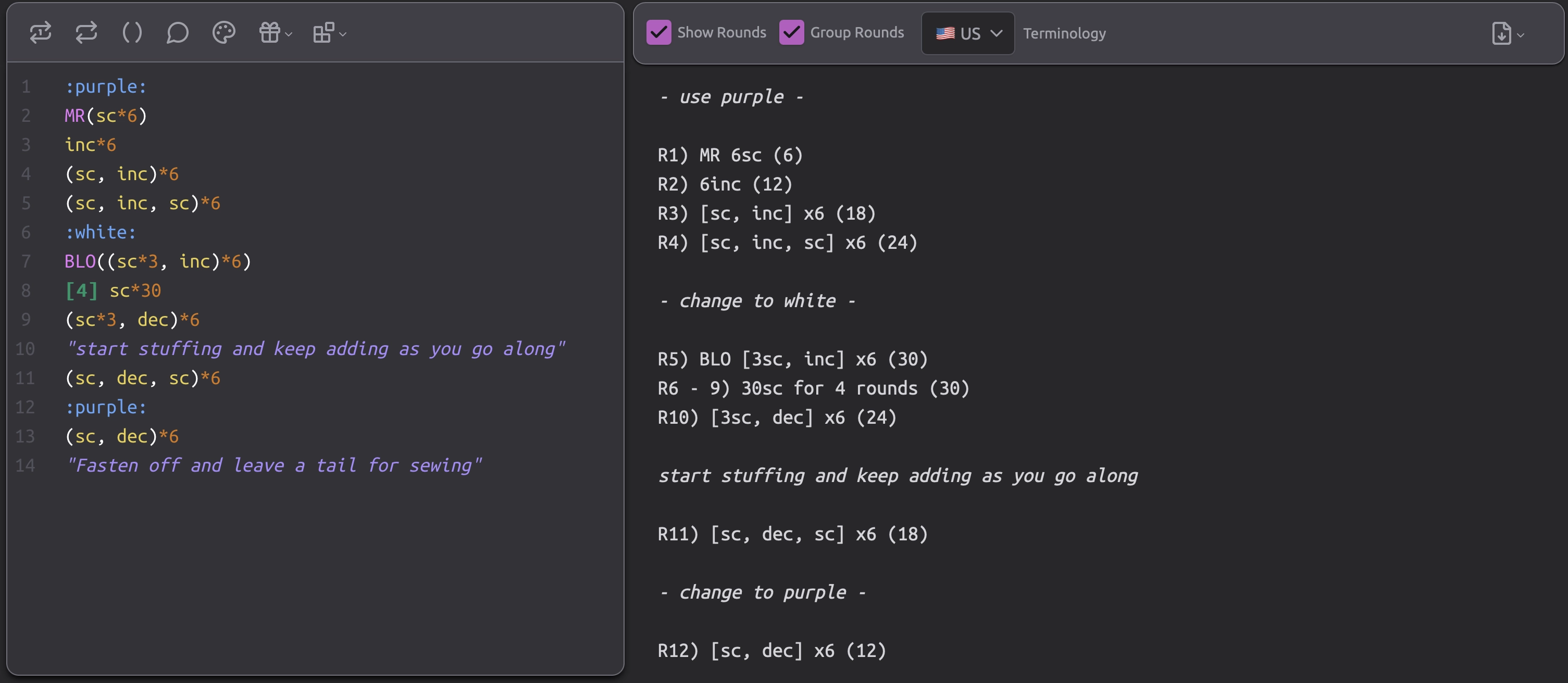 The editor will not only auto generate all your stitch counts and row/round numbers for you (meaning you will never have to up all round numbers after inserting another round later on). It will also check whether you have actually cared for & used all stitches of the previous round with each round. This exponentially reduces the risk of errors in your crochet patterns and reduces the effort for mundane tasks such as checking stitch counts and adding round numbers.The hard frogg's life crochet pattern maker also answers the question: "where do I put my pattern notes to not lose 'em?" You basically have your own lil' design buddy (in frog shape) with you that you feed with all your notes, update them and BAAM you got a crochet pattern in front of you.
The editor will not only auto generate all your stitch counts and row/round numbers for you (meaning you will never have to up all round numbers after inserting another round later on). It will also check whether you have actually cared for & used all stitches of the previous round with each round. This exponentially reduces the risk of errors in your crochet patterns and reduces the effort for mundane tasks such as checking stitch counts and adding round numbers.The hard frogg's life crochet pattern maker also answers the question: "where do I put my pattern notes to not lose 'em?" You basically have your own lil' design buddy (in frog shape) with you that you feed with all your notes, update them and BAAM you got a crochet pattern in front of you.
Related Guides
- How to Design Your Own AmigurumiLove crocheting Amigurumi, but finally want to be able to design your very own plushie pieces? This guide is for you!
- What Are Crochet Pattern Tests?You've written a crochet pattern — amazing! But before you share it with the world, you need pattern testers. Here's why and how.
- US vs UK Crochet TerminologyUS and UK crochet terms use the same words for different stitches. Here's the complete side-by-side translation guide.
- Why You Need a Dedicated Crochet Pattern MakerGoogle Docs, Word, Canva — none of them were built for crochet patterns. Here's why a dedicated editor is not a luxury, it's a necessity.
- Exporting Crochet Patterns as MarkdownYour pattern lives in the editor — markdown is just one export format. Here's why it's the perfect choice for embedding patterns on blogs and websites.
- Pattern Maker User DocumentationNot sure where to start on your crochet pattern maker journey? Peep some of the user documentation and become a master in no time.