What are Crochet Pattern Tests?
You wrote a pattern — now what?
So you've designed your very own crochet pattern. You crocheted it yourself, it came out looking adorable, and now you're ready to unleash it upon the world. Hold up. Before you hit publish or list it on Etsy or Ravelry, there's one more step that separates a "meh" pattern from a "shut up and take my money" pattern — and that's pattern testing. Pattern testing is basically having other crocheters try to make your thing using only your written instructions. No peeking over your shoulder, no "oh yeah I forgot to mention that part." Just them, your pattern, and their hook. If they can make it and it looks right? Congrats, your pattern works. If they end up with something that looks like it's having an existential crisis? Well, now you know what to fix. Better to find out now than after 200 people bought it.
Why pattern testing matters
Here's the thing — when you wrote that pattern, you already know what the finished piece is supposed to look like. You know that "the weird bit in round 14" actually means you should switch to the other color. But a stranger reading your pattern? They don't have your brain. They only have your words. And let me tell you, your words might not be as clear as you think. We all have blind spots. Pattern testing catches:
- Typos and mistakes — a mistyped stitch count, a missing increase, a round that doesn't add up. The classic "oops" stuff that slips past you because you've read it 47 times already.
- Confusing instructions — something that made perfect sense in your head but reads like ancient riddles to everyone else.
- Structural issues — maybe the proportions are off when someone else makes it with slightly different tension, or the arms are weirdly long on anyone's version but yours.
- Missing info — did you forget to mention the hook size? The yarn weight? That the ears need to be sewn on before stuffing the head? These things happen.
How does pattern testing work?
The process is pretty straightforward, even if it takes a bit of patience:
Find your testers
You can find pattern testers in Facebook groups, on Instagram, Reddit, Ravelry forums, or Discord servers dedicated to crochet. Some designers also build up a pool of trusted testers over time. Usually you post a "tester call" with a photo of the finished piece, the skill level required, the yarn weight, and a deadline.Send out the pattern
Share your pattern (usually as a PDF) with the testers. Make sure they know which terminology you're using (US or UK — see our guide on writing crochet patterns if you're unsure), and give them a deadline that's realistic — most testers do this in their free time alongside their own projects. Two to three weeks is common for a standard Amigurumi, more for bigger or complex pieces.Testers crochet and report back
Your testers work through the pattern and note down anything that trips them up — unclear instructions, wrong stitch counts, sections where they got lost, or parts where the shape just didn't come out right. Good testers also send you photos of their progress and finished piece so you can compare.Collect feedback and revise
This is where the magic happens. Go through all the feedback, look for common themes (if three out of five testers got confused at round 12, that's on you, not them), and update your pattern accordingly. Fix the errors, clarify the confusing bits, add that missing materials note.Final check and publish
Once you've made your revisions, give the pattern one last read-through yourself. Some designers even do a second round of testing for complex patterns. When you're confident it's solid — ship it. Your pattern is now battle-tested and ready for the world.
What makes a good pattern tester?
Not all testers are created equal, and that's okay. Here's what to look for when picking your testing crew:
- They actually finish on time — this sounds obvious but you'd be surprised how many testers ghost after signing up. Life happens, but reliable testers are worth their weight in yarn.
- They give honest feedback — you don't want someone who just says "looks great!" when round 8 clearly doesn't work. You want the tester who says "hey, I think there's a stitch missing here and the ear looks wonky."
- They match the skill level — if your pattern is beginner-friendly, get some actual beginners to test it. If it's advanced, get experienced hookers (yes, that's what we call ourselves) who can tell you whether your bobble stitch instructions make sense.
- They send photos — photos of the finished piece are incredibly valuable. They show you how the pattern translates across different yarn types, colors, and tension styles. Plus, you can use tester photos (with permission) when you list your pattern for sale. Win-win.
What do testers get out of it?
Pattern testing is usually a volunteer gig, but that doesn't mean testers walk away empty-handed. Most designers offer the finished pattern for free as a thank-you, and testers get to make a cool new project before anyone else. Some designers also give credit in the pattern listing or share tester photos on their socials. It's a nice little community thing — designers get better patterns, testers get free patterns and early access. Everybody wins.
Make your patterns test-ready with hard frogg's life
Before you even send your pattern out to testers, you want to make sure the basics are solid — stitch counts add up, round numbers are correct, and there are no obvious gaps. The hard frogg's life crochet pattern editor helps you catch those issues before a human ever has to.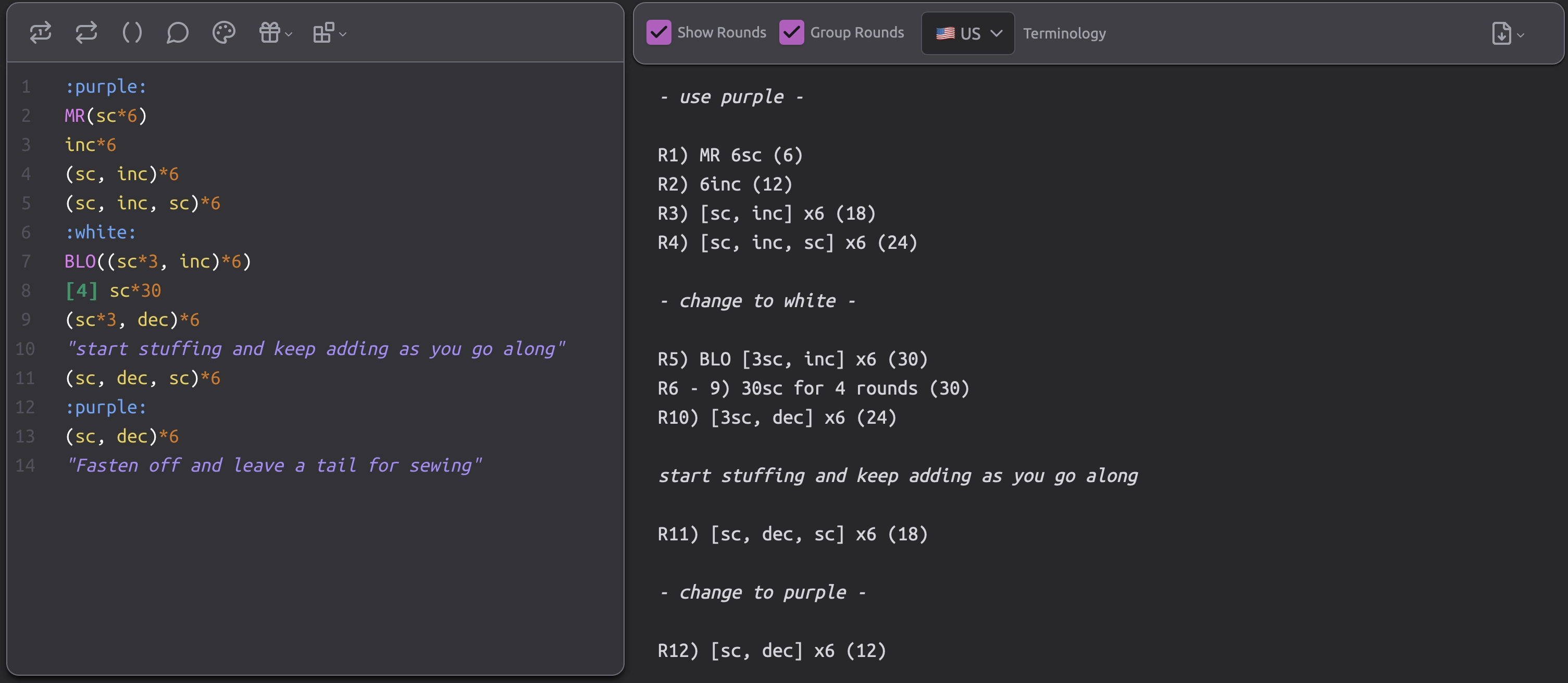 The editor will not only auto generate all your stitch counts and row/round numbers for you (meaning you will never have to update all round numbers after inserting another round later on). It will also check whether you have actually cared for & used all stitches of the previous round with each round. This exponentially reduces the risk of errors in your crochet patterns and reduces the effort for mundane tasks such as checking stitch counts and adding round numbers.Think of it this way — the editor catches the math mistakes so your testers can focus on the real stuff: does the pattern read well, do the shapes come out right, and does the finished piece look like what you intended? The fewer basic errors your testers have to deal with, the more useful their feedback will be. And the more polished your pattern is before testing, the faster you get to that sweet, sweet "ready to publish" moment.
The editor will not only auto generate all your stitch counts and row/round numbers for you (meaning you will never have to update all round numbers after inserting another round later on). It will also check whether you have actually cared for & used all stitches of the previous round with each round. This exponentially reduces the risk of errors in your crochet patterns and reduces the effort for mundane tasks such as checking stitch counts and adding round numbers.Think of it this way — the editor catches the math mistakes so your testers can focus on the real stuff: does the pattern read well, do the shapes come out right, and does the finished piece look like what you intended? The fewer basic errors your testers have to deal with, the more useful their feedback will be. And the more polished your pattern is before testing, the faster you get to that sweet, sweet "ready to publish" moment.